Emotional Gravity: Why You Keep Getting Pulled Back to the Same Kind of Pain
I watched a video recently by a behavioral expert named Chase Hughes that genuinely explains something I've been trying to articulate for quite a while. He was talking about why we keep getting pulled toward the same kind of person, the same kind of dynamic, the same kind of pain, over and over, even after we've sworn up and down that we've learned our lesson. And the term he uses for it, emotional gravity, explained something I've watched play out in almost every woman I've ever worked with. If I'm being fully honest, I've watched it play out in my own life too, more than once.
So I want to break this down properly, give Hughes full credit for the framework because it's genuinely brilliant, and then talk about what it actually means for you if you're dating again after a breakup, or if you're sitting there right now wondering why your love life keeps rhyming with itself even though the names keep changing.

What Emotional Gravity Actually Is
Here's the thing Hughes says that I think everyone needs to hear at some point in their healing. This isn't about habits. It's not some vague thing about your mindset needing work. He calls it emotional gravity, which he describes as the pull, the little gravity vortex your emotions get sucked into without your permission. It's the quiet voice in the back of your mind that says I need that thing, even if it's bad for me. Even if it hurts.
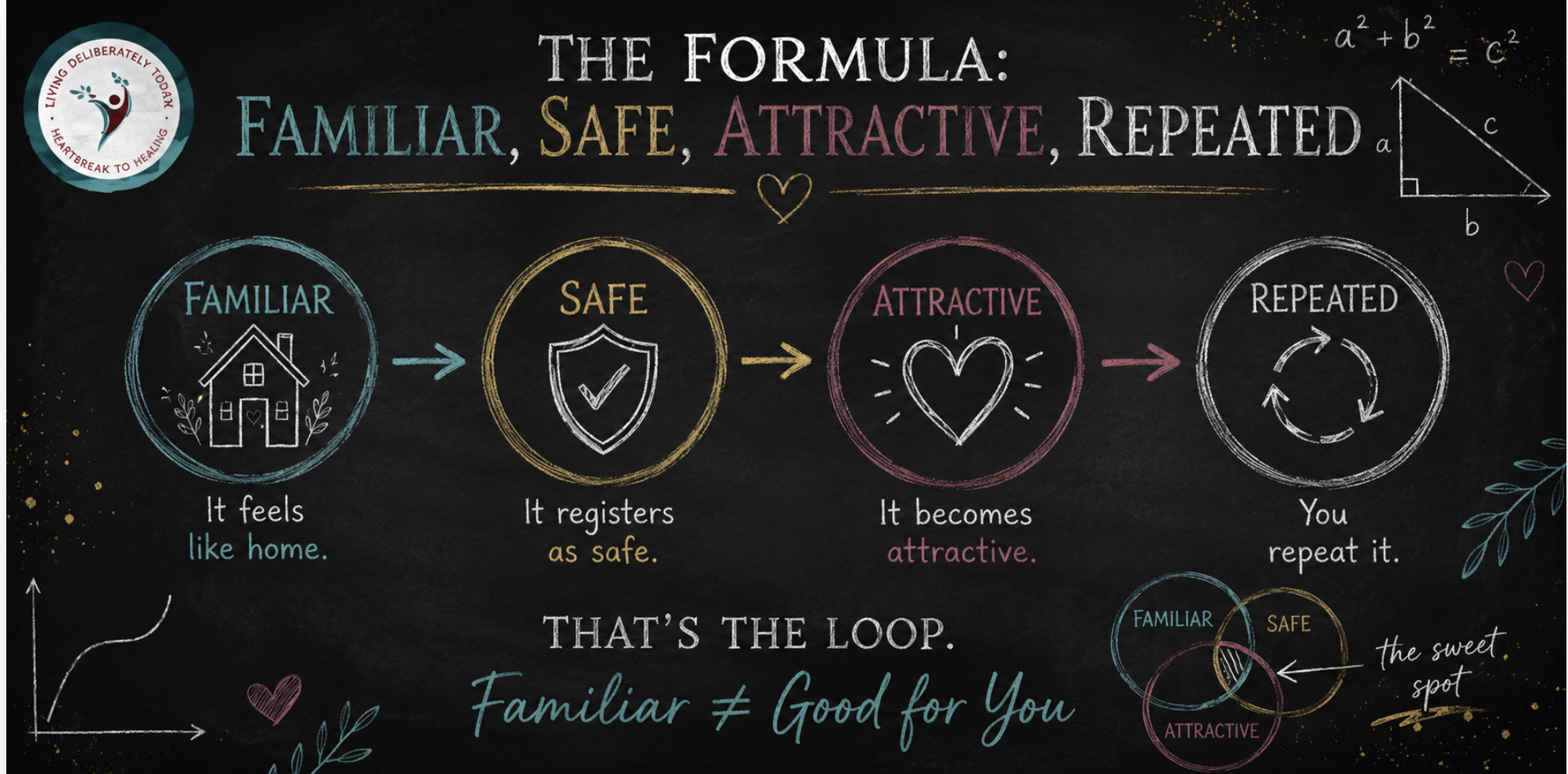
And here's the line that really got me. Your nervous system does not want what's healthy. It wants what's familiar.
If it feels familiar, it feels safe.
If it feels safe, it feels attractive.
If it feels attractive, you repeat it.
BAM!!!
Read that again if you need to, because it's not the same sentence with different words. Healthy and familiar are two completely different categories, and most of us have spent our whole dating lives assuming they were the same thing.

Your Brain Isn't Chasing What Feels Good. It's Chasing What Feels Like Home.
This is the part that reframes everything. Your brain isn't out here trying to maximize your happiness. It's trying to keep you alive using whatever information it has, and the information it has comes from childhood. So if you grew up around chaos, peace is going to feel weirdly uncomfortable to your system, not because peace is bad, but because your brain has never filed peace under safe. If you grew up being ignored, you might find yourself strangely drawn to people who barely give you attention, because inconsistency, painful as it is, at least feels recognizable. Even if home was genuinely hell, some part of you is still homesick for it. That's not a flaw in your character. That's just how nervous systems work.
The Formula: Familiar, Safe, Attractive, Repeated
Hughes breaks it down into a sequence that's almost annoyingly simple once you see it. If something feels familiar, it registers as safe. If it feels safe, it becomes attractive. And if it's attractive, you repeat it. Familiar, safe, attractive, repeated. That's the whole loop.
But I want to be really clear about something, because this is where people get it twisted. Familiar does not mean good for you. It just means your nervous system has seen it before. That's it. That's all familiar means. Your gut can absolutely tell you that something feels like home and be dead wrong about whether that home was ever a place you should have been living. Chemistry and familiarity get treated like they're the same thing constantly, and they are not. Sometimes what you're calling chemistry is just your nervous system recognizing an old wound and getting a little excited about it, like a dog that hears its own name.
So this is your permission slip to stop treating the pull as a compass. The pull tells you what's familiar. It does not tell you what's right for you. Those can be the exact same things sometimes. They're very often not.
The Four Types of Emotional Magnets
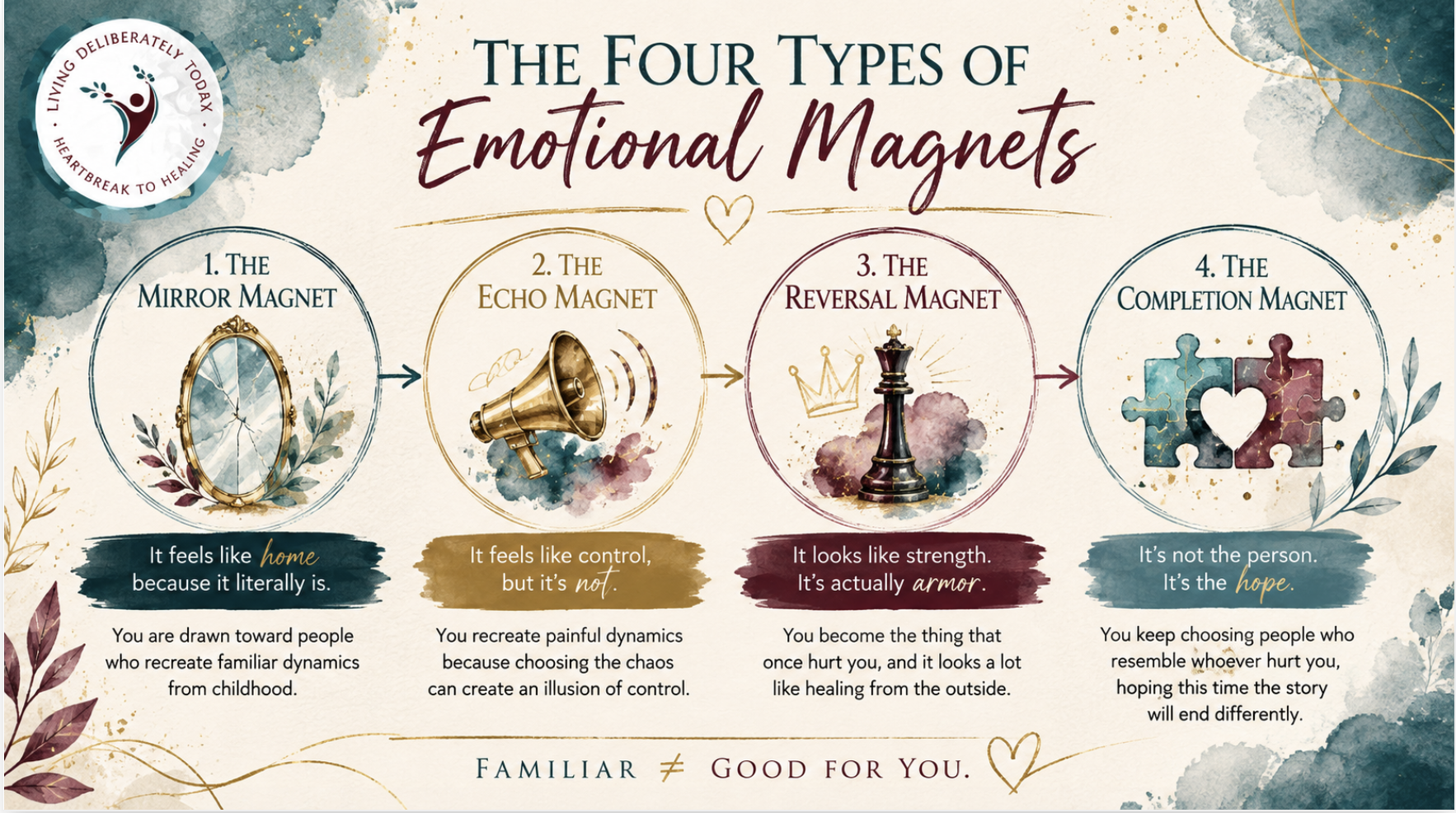
Hughes lays out four specific patterns, and I want to walkthrough all of them because I promise you'll recognize at least one, either in yourself or in someone you've dated.
1. The Mirror Magnet
This one pulls you toward people who treat you the way you were treated growing up. If a parent was critical, you find critical partners. If a parent was emotionally distant, you find yourself drawn to people who are, in Hughes's words, emotionally three states away from you. The relationship becomes a mirror of the original dynamic, and it feels like home because it literally is.
2. The Echo Magnet
This one is sneaky. It has you recreating pain because it gives you a placebo of control. If you're the one who chooses the chaos, chooses the drama, chooses the burnout, some part of you feels like you're finally the one holding the match instead of just getting burned. It's not actual control. It just feels like it, which is often enough to keep the cycle going.
3. The Reversal Magnet
This one flips the script entirely. You become the thing that once hurt you. If you felt powerless, you become the dominant one. If you were invisible, you become the loudest person in every room. And here's the part that stings a little: it can look a lot like healing from the outside. It's respected. It's effective, even. But it's armor with a smile on it. It's not actually healing anything. It's just moving the pain to a different seat at the table.
4. The Completion Magnet
This one might be the most heartbreaking of the four. You keep finding people who resemble whoever hurt you, hoping that this time, finally, you'll get the love you didn't get back then. Hughes calls it exactly what it is: you're not dating the person in front of you. You're dating the hope that this time the monster becomes safe. It'sGroundhog Day, but with trauma. And it explains so much about why some of us keep ending up in relationships that a good friend could have called from a mile away.
How to Actually Break the Pattern
Okay, so now that you've probably identified yourself somewhere in those four descriptions, let's talk about what to actually do with that information, because awareness alone doesn't fix anything. Hughes gives four steps, and I think they're genuinely useful.
Step one is spotting the loop. Ask yourself plainly: what keeps happening that I say I don't want, but I keep allowing? Step two is naming the magnet. Which of the four is running the show? Mirror, echo, reversal, or completion? Step three is tracing it back to the source, and this is where it gets a little uncomfortable. Who taught you that this was normal? Whose love came with conditions? And the big one: who in your life made you feel like safety has a cost, like you had to earn it or pay for it somehow?
Step four is exposing the lie. That pull you feel, the adrenaline spike, the butterflies, the this-feels-so-right sensation, trace it back and you'll usually find it's your nervous system recognizing something from childhood, not your intuition confirming a good match.

Why Peace Feels Boring at First (And Why That's Not a Red Flag)
This is genuinely the part ofHughes's video that stuck with me the most, and I think it might be the most important thing in this entire article. If your nervous system has been wired for chaos, peace is not going to feel peaceful right away. It's going to feel like something's missing. It's going to feel boring, maybe even a little unsettling, like you're waiting for the other shoe to drop.
And here's the crucial part. That feeling is not a sign you made the wrong choice. It's not proof that this calmer person or this healthier dynamic isn't right for you. It's withdrawal. You are, quite literally, detoxing from a version of love that was actually just pain wearing a familiar costume. The absence of adrenaline is going to try to trick you into going back to whatever gave you that hit. That's the trap talking, not your gut.
So if you're dating someone new and stable and it feels a little flat compared to what you're used to, before you write them off as boring, ask yourself honestly whether it's actually flat,or whether it's just unfamiliar. Those are two very different things, and only one of them is a real reason to walk away.
Where EFT Tapping Comes In
Hughes gives you an excellent map. Spot the loop, name the magnet, trace the source, expose the lie. That's real, valuable cognitive work, and I don't want to undersell it. But here's what I've seen consistently in the women I work with: understanding where the pull comes from doesn't automatically make the pull go away. You can know exactly why you're drawn to emotionally unavailable people and still feel the pull the next time one shows up in a bar looking effortlessly unbothered.
That's because the charge underneath the pattern is emotional, not intellectual. It's stored in the body, in that specific felt sense of what home used to feel like, and that's exactly the layer EFT tapping works on. Tapping doesn't just help you understand the pattern. It releases the emotional grip the pattern has on you, so the pull actually loses some of its power instead of just becoming a pull you're now more educated about.
This kind of work, tracing the pattern and then actually releasing what's underneath it, is a core part of the Rebuild phase inside The Release, Rebuild & Rise Journey. Because knowing the four types of magnets is genuinely useful. But feeling the charge finally let go is what actually changes what you're attracted to next.
The Real Takeaway
Credit where it's absolutely due: Chase Hughes put language to something a lot of us have felt for years without ever being able to name. Emotional gravity. The idea that we're not choosing, we're recycling. It's a brilliant, uncomfortable, necessary reframe, and I think everyone reading this should go watch his original video for themselves.
But here's what I want you to walk away with. Familiar was never supposed to be your compass. It's just a record of where you've already been. What you're building now, whether that's in this relationship, the next one, or just in how you talk to yourself, gets to be based on something better than what your nervous system already recognizes. It gets to be based on what's actually good for you. Those two things can eventually become the same. They just aren't yet, and that's okay. That's the whole point of doing the work.
RESOURCES:
💛 Free EFT Tapping Heartbreak Guide: https://snipr.is/A89rTcU
Get my book on Amazon Kindle: From Heartache to Healing: How EFT Tapping Can Mend a Broken Heart: https://amzn.to/4fzLPP8
Get my Free Guide 10 Ways you know you’re ready to travel after a breakup: https://snipr.is/h8KepU3
📞 Book a Discovery Call (Travel Coaching After a Breakup or EFT for Confidence): https://events.dreahunt.com/book-a-call
More like this...


7 Things That Happen When You Don't Heal From Your Breakup
What actually happens when you skip the real work after a breakup: old attachment wounds, low self-worth, patterns that follow you into the next relationship, and why EFT is the tool that actually moves it.
read more
5 Red Flags Your Ex Showed You That Should Make You Glad You Walked Away
Missing your ex and wondering if you made the right call? These 5 red flags are a reminder of what was actually there, and why walking away was the right thing, even when it doesn't feel like it yet.
read more
Why Can't You Get Over Them? 5 Reasons You're Still Not Over Your Ex
Do you still feel like you're not over your ex even though it's much later? Here are 5 reasons why you might be stuck..
read more