
I'm going to say something that probably sounds a bit weird: your brain physically changed during your relationship. And it needs to change again to heal from the breakup. I know that sounds maybe dramatic, but it's actually just neuroscience. And understanding this might be the most important thing you learn about healing from heartbreak.
Because here's what nobody tells you: all that "time heals all wounds" advice? It's incomplete at best. If that was the truth, so many people would NOT have 'the one that got away'. By the way, I don't think that's accurate either and instead is indicative of unhealed wounds but that's for another article. The thing is that time alone doesn't rewire your brain. And your brain is exactly what needs rewiring right now so your heart can feel better. So how do we do that? By tapping on our faces. I know it sounds odd, but read on to learn how EFT Tapping is so important during a breakup.
What Actually Happens in Your Brain During a Breakup
Let's talk about what's really going on in there. Your brain created specific neural pathways for your ex. Every shared experience, every routine, every inside joke, every fight, every makeup session strengthened those pathways. These aren't just memories floating around. They're physical structures in your brain. Actual highways of neurons that fire together. You know how you automatically reach for your phone to text them something funny, and then remember they're not yours to text anymore? That's a neural pathway. You know how you still turn to tell them something even though they're not there? Neural pathway. You know how certain songs or places or smells just completely wreck you? Neural pathways lighting up like a Christmas tree.
Your brain spent months or years creating efficient routes to thoughts of your ex. It got really good at traveling those routes. And now that the relationship is over, your brain is still taking those routes because that's what brains do. They follow established patterns.
But here's where it gets worse. If your ex criticized you, if they made you feel less than, if they told you that you were too much or not enough or fundamentally flawed in some way, those criticisms also created neural pathways. "I'm not good enough" became a physical pathway in your brain. And your brain started automatically firing that pathway in all kinds of situations that have nothing to do with your ex.
Like at work. In meetings. When you're trying to make decisions. When you're meeting new people. Your brain just automatically goes there now because that pathway exists and it's strong.

What Is Neuroplasticity and Why Should You Care?
If you've never heard about it, neuroplasticity is your brain's ability to form new neural connections and change its structure. Which means you're not stuck with the pathways your relationship created. Your brain can literally change.
Old pathways weaken when you stop using them. New pathways strengthen when you repeatedly use them. Your brain is constantly reshaping itself based on what you're doing, thinking, and experiencing. Bit by bit.
This is really good news. It means healing from your breakup isn't about waiting for time to pass. It's about actively rewiring your brain to create new patterns. But here's the thing: you can't just think your way into new neural pathways. You can't positive-affirmation yourself into a rewired brain. Because neural pathways aren't just cognitive. They're somatic. They involve your entire nervous system.
And that's why willpower alone doesn't work for breakup recovery. You're trying to use conscious thought to override physical neural structures that fire automatically. It's like trying to think your way into not being hungry. Your brain knows you're lying.
Why Traditional Breakup Recovery Methods Fall Short
Let’s talk about why so much breakup advice doesn’t do much to rewire your brain. I’m not dismissing any of it. Most of it helps, and it can certainly lessen the pain. But for a lot of people it doesn’t release the emotional charge underneath, and that’s the part that keeps pulling you back. Here’s where each of the usual approaches tends to stop short:
Talk therapy: I want to say that first of all, I'm not knocking therapy. I've done it and it was helpful. It’s great for understanding what happened, making sense of the story, and spotting your patterns. But understanding why you feel bad doesn’t automatically change how you feel. You can spend months talking through a breakup and still have the same neural pathways firing every time your phone lights up. Insight is valuable, and it doesn’t always reach the pathways that do the firing. When I started digging around childhood wounds I retriggered myself and would start the week feeling absolutely awful instead of relieved.
"Time heals all wounds”: It’s partly true, and time can help. But time on its own doesn’t rewire anything, and what happens during it matters. If those months go to ruminating on the same thoughts, replaying the same scenes, and reinforcing the same beliefs, the old pathways get stronger with every repetition.
Positive affirmations: They sound lovely and they have their place. But picture standing at the mirror saying “I am confident and worthy” while another part of you answers, “then why did they leave?” That gap creates cognitive dissonance, and your brain tends to believe whichever pathway is stronger. Usually that’s the old one.
Staying busy: The packed calendar, the new workout routine, the weekend trips, the extra hours at work. A lot of that is great, and wanting a break from the pain is completely reasonable. The feelings tend to hang around until things get quiet, which is why they often show up in the shower or at 2am. Every time you steer away from a thought, your brain also gets the message that it’s something to escape, and that can make it feel bigger the next time it comes up.

How EFT Tapping Leverages Neuroplasticity
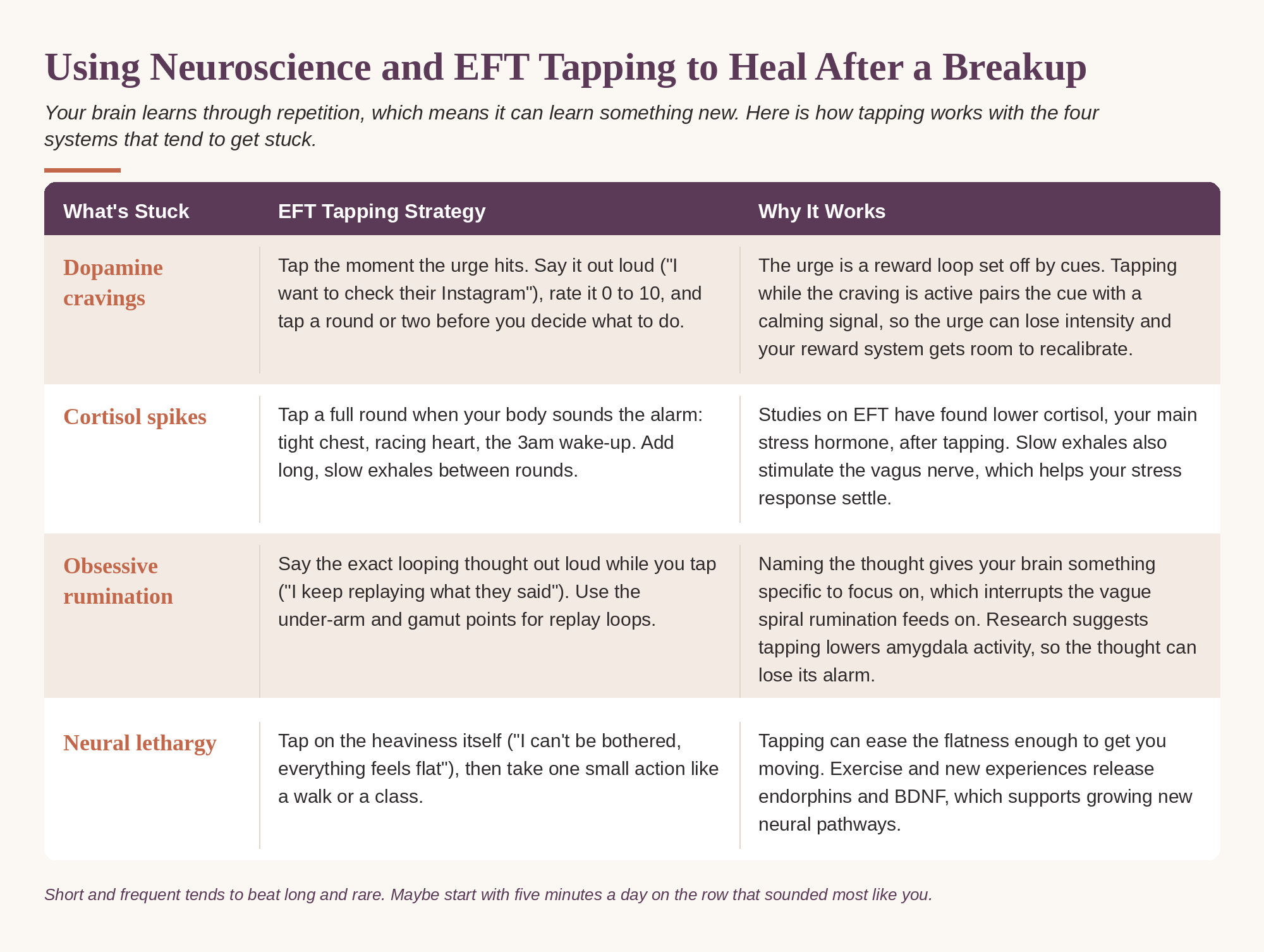
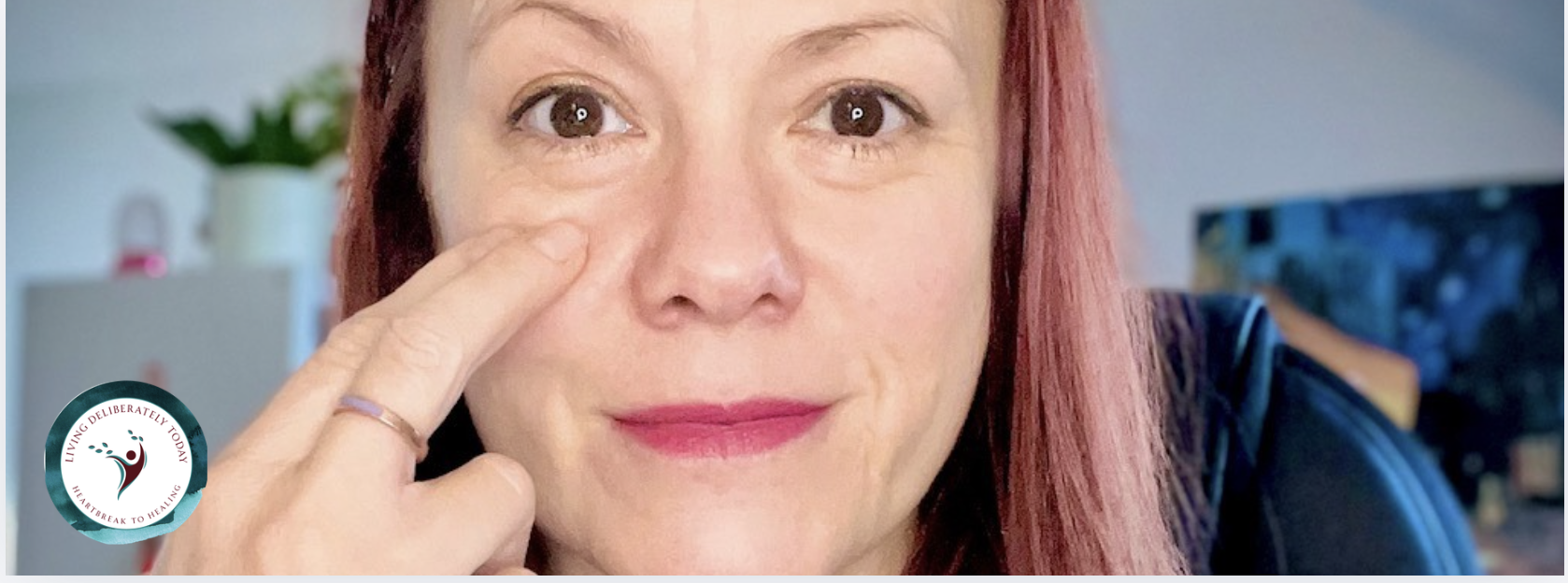
This is the part where I get a little nerdy. EFT tapping means you tap with your fingertips on acupressure points on your face and upper body (the eyebrow, the side of the eye, under the eye, under the nose, the chin, the collarbone, and under the arm) while you say out loud the exact thing that hurts. Something like “I keep checking whether they looked at my story” or “I’m scared nobody will ever get me like that again.” The more specific the sentence, the better, because your brain gets something concrete to work with.
So what’s going on while you do that? The tapping sends calming signals to your amygdala, the part of your brain that scans for threat and handles big emotions. Some studies on EFT have found lower cortisol, which is your main stress hormone, and changes in amygdala activity after tapping. At the same moment, you’re thinking about the very thing that normally sets your stress response off. That combination is the interesting part.
Think about what usually happens when your ex crosses your mind. Maybe your chest tightens, your heart picks up, your stomach drops. Your amygdala reads the thought as a threat and sounds the alarm, and your body follows its lead. Each time that happens, the link between that thought and that alarm gets a little stronger, the way a path through a field gets more worn the more you walk it.
Tapping gives your brain a different experience of the same thought. You’re thinking about your ex while your body gets a calming signal, so the alarm doesn’t get to build the way it usually does. Many practitioners and researchers connect this to something called memory reconsolidation, the idea that when you bring up a memory or belief while you’re calm, your brain gets a chance to update it.
The old pathway says: “thought of ex = danger = stress response.” <-- heightened anxiety, fear, panic, sadness.
The new pathway you’re creating says: “thought of ex = awareness. I can be calm = no stress response.” <- emotional charge lower.
That also explains why I have you rate the intensity from 0 to 10 before and after each round. You’re watching the number come down, which gives your brain real evidence that the old pathway is losing its grip. Do this repeatedly, and the old pathway weakens while the new one strengthens. That’s neuroplasticity in action.

What Specific Changes Can EFT Tapping Make in Your Brain After a Breakup?
Before we get into it, I want to be clear about something. I’m not a trauma specialist, and I’m not offering therapy. I’m a coach, and EFT is a tool that can support trauma-informed coaching by helping your body settle while you work through hard emotions. If what comes up after your breakup feels heavy or overwhelming, a licensed therapist or trauma specialist is the right person to have in your corner, and tapping can happily sit alongside that work.
With that said, here are four specific places where tapping can make a difference after a breakup.
How Does EFT Tapping Calm Breakup Triggers?
A breakup can feel like a threat to your brain. Losing someone you were attached to can set off the same alarm system that responds to danger, so a song, a restaurant, a street corner, even a certain time of day can bring on a racing heart, a tight chest, or a sudden wave of dread. Your brain learned to link those things with the pain of the breakup, and the link fires automatically. When you tap while you bring up the trigger and say it out loud (“every time I hear that song, my stomach drops”), your body gets a calming signal at the same moment. Over time, that can loosen the link. Maybe the day comes when you hear that song, notice it, and carry on with your afternoon.
Can EFT Tapping Change the Beliefs Formed During a Relationship?
Maybe somewhere along the way you started believing things like “I’m too much,” “I’m not enough,” or “I can’t trust my judgment.” Some of those might have come from things an ex said, and some may go back much further. Beliefs like these fire fast because they’ve been repeated so often and because strong emotion came attached. With tapping, you say the belief out loud, rate how true it feels from 0 to 10, and tap until the emotional charge around it comes down. Once the intensity eases, a lot of people find it easier to try on a new belief, and repetition gives that new belief room to settle in.
How Does EFT Tapping Help Rebuild Confidence After a Breakup?
Confidence is a pattern your brain and body build through experience, a collection of connections that adds up to the felt sense of “I can handle this.” A breakup can shake that pattern, especially when it chipped away at how you saw yourself in the relationship. Tapping on the doubts as they come up (“I don’t trust my own judgment anymore”) and then on the confidence you want to build (“I’m learning to trust myself again”) can help you grow a kind of self-trust that doesn’t depend on anyone else’s approval. It strengthens with repetition, the same way the old doubts did.
Can EFT Tapping Help You Process Grief in Your Body?
Grief often shows up physically. Maybe it’s a heavy chest, tight shoulders, a knot in your stomach, or nights when sleep won’t come. It starts with the heartbreak, and your body responds to it. Talking about your feelings helps, and tapping adds a way to work with the physical side at the same time. You name the feeling, tap the points, and notice where the sensation sits in your body and whether it shifts. Over time, that gives your body a practiced way to settle that it can reach for on its own.
The Science that Backs Up EFT Tapping
If this all sounds a little weird, I get it. Tapping on your face while you say your feelings out loud isn’t what most of us picture when we think about healing a broken heart. I was curious about the research too, so here’s what’s out there.
Let’s start with cortisol, your main stress hormone. In a 2012 randomized controlled trial by Dawson Church, Garret Yount, and Audrey Brooks, 83 people received one hour of EFT, one hour with a licensed therapist, or no treatment at all (they just rested). Cortisol dropped about 24 percent in the EFT group, compared with about 14 percent in each of the other two. A 2020 replication from Peta Stapleton and her team at Bond University, with 53 participants, found a 43 percent drop in the EFT group. Both measured cortisol after a single session. Research on chronic stress suggests that high cortisol can make learning and memory harder, so lowering it may help your brain stay open to forming new pathways.
Brain imaging is a newer area. In 2022, Stapleton and colleagues scanned 24 adults with chronic pain before and after a six-week online EFT program. Afterward, the connectivity between the medial prefrontal cortex and brain areas linked to pain processing and catastrophizing had decreased. That study looked at people with chronic pain and had no control group, so I see it as an early peek at what changes in the brain after tapping, and I’d love to see more studies on heartbreak specifically.
There’s also research on trauma and anxiety. In a 2013 randomized trial of 59 veterans, 90 percent of the group who received six EFT sessions alongside their usual care no longer met the criteria for PTSD, compared with 4 percent of the group still waiting. A 2025 systematic review of seven randomized trials with 506 participants found that EFT reduced anxiety more than no treatment and performed about the same as CBT in the one trial that compared them. The authors called EFT a promising and safe complementary approach, and they asked for larger, higher-quality studies. Many of the studies so far are small, so I’d call this a growing body of research rather than a settled one.
Does any of this study breakups directly? Not that I know of. Heartbreak can bring up a lot of the same stress and fear responses these studies looked at, which is why I think the findings are worth paying attention to. Neuroplasticity research also tells us that pathways get stronger the more we use them, so doing a little tapping often tends to make more sense than doing it once and waiting for everything to change.
Sources:
- Church, Yount & Brooks (2012), stress biochemistry RCT
- Stapleton et al. (2020), cortisol replication, with a plain-language summary of the 43% result
- Stapleton et al. (2022), neural changes after EFT for chronic pain
- Church et al. (2013), veterans and PTSD
- Choi, Sung & Lee (2025), systematic review of EFT for anxiety

How to Use EFT Tapping for Breakup Recovery
Knowing the science is one thing. Actually using it is another. There are different paths you can take, from trying YouTube videos, using the Tapping Solution App.
Consistency is everything. Neural pathways require repetition to change. You can't tap once and expect your brain to rewire. You need to tap daily, ideally multiple times a day, to weaken old pathways and strengthen new ones. Morning routines are particularly powerful because you're establishing new patterns right as you wake up, before your brain falls into its default pathways.
Target specific beliefs. Generic tapping is less effective than targeted work. You need to identify the exact beliefs your ex left behind. Not just "I feel sad." But "I'm not good enough," "I can't trust my judgment," "something is fundamentally wrong with me." These specific beliefs are specific neural pathways. Name them. Tap on them. Create new pathways that contradict them.
Combine EFT with other neuroplasticity practices. New experiences create new neural pathways. This is why solo travel after a breakup can be so powerful. You're in a completely new environment, having new experiences, meeting new people. Your brain is forming pathways that have nothing to do with your ex. Movement also helps rewire the nervous system. Social connections activate different neural networks. EFT is powerful, but it's even more powerful when combined with other practices that support neuroplasticity.

What to Expect: The Timeline of Neural Rewiring
Let's be real about timelines because I don't want you to expect overnight miracles.
First few weeks: You'll notice immediate nervous system regulation. After a tapping session, you'll feel calmer. But this doesn't mean the neural pathways are rewired yet. You're interrupting old patterns, which is important, but the pathways are still there and still strong. You're in the disruption phase.
One to three months: This is when new pathways start to form. You're not just interrupting old patterns anymore, you're actively building new ones. Old pathways are beginning to weaken because you're not using them as much. But this still requires active, consistent work. The new pathways aren't automatic yet.
Three to six months: Significant neural changes are possible at this point if you've been consistent. New patterns are becoming more automatic. You notice that triggers don't hit as hard. The beliefs that used to feel absolutely true now feel less convincing. You can think about your ex without your nervous system going haywire. The old pathways are significantly weaker. The new pathways are getting stronger.
This doesn't mean you're "fixed" at six months. Neural change is ongoing. But you've created new default pathways that serve you better than the old ones.

Your Brain is Not Stuck
Can your brain actually heal after a breakup? Yes. Thanks to neuroplasticity, your brain can form new neural pathways at any age. The pathways your relationship created can be rewired. The limiting beliefs your ex reinforced can be cleared. The confidence that was damaged can be rebuilt. You have more control over your healing after heartbreak than you’ve been led to believe.
Neuroplasticity means change is always possible. Your brain is designed to adapt, to form new connections, to create new patterns. It’s doing this all the time whether you’re directing it or not. The real question is this: are you actively creating new neural pathways that serve you, or are you passively reinforcing the old pathways that keep you stuck in heartbreak?
EFT tapping works because it leverages your brain’s natural ability to change. Published research shows that EFT reduces cortisol, calms the amygdala (the brain’s threat center), and creates lasting change at the neural level instead of just managing symptoms at the cognitive level. It addresses both the nervous system and the belief patterns at the same time.
This is why you can understand everything about your breakup, have complete clarity on why it ended, know intellectually that you’re worthy and capable, and still feel terrible. The neural pathways haven’t changed. You have cognitive understanding without somatic rewiring.
EFT bridges that gap. It gives you a tool that works at the actual level where the problem exists, inside your nervous system and your neural pathways.

Next Steps
If you're reading this and thinking "okay, I get the science, but how do I actually do this," that's the right question.
Start with consistent daily tapping. Even five minutes in the morning can begin the rewiring process. Target the specific beliefs from your relationship. Don't just tap on "I'm sad about my breakup." Tap on "he told me I was too needy and now I'm afraid to have needs" or "she said I wasn't ambitious enough and now I doubt every decision I make at work."
Give your brain time to rewire. This isn't a quick fix. Neural change takes repetition and consistency. But it works. And it's working at the level where actual, lasting change happens.
Your brain changed during your relationship. It can change again after your breakup. The pathways that are keeping you stuck right now don't have to stay that way. You can actively rewire them. That's not just hope. That's neuroscience.
Ready to start rewiring your brain? My Healing Your Heartbreak Workshop teaches specific EFT tapping protocols for breakup recovery. You'll learn how to target the exact neural pathways keeping you stuck, how to clear limiting beliefs at the somatic level, and how to rebuild your confidence from the inside out. €27 includes the live workshop, a free chapter from my book, and 30 days of WhatsApp support.
About Me:
Andrea Hunt is a Heartbreak to Healing EFT Tapping Coach based in Munich, Germany, and the founder of Living Deliberately Today. She helps women heal after a breakup, rebuild their confidence, and create a fulfilling life they love, with or without a partner. Her work combines EFT tapping, deliberate living, and solo travel as part of the healing journey.
Resources
💛 Free EFT Tapping for Heartbreak Guide: https://snipr.is/A89rTcU
💛Get instant access to my free 3-day Heartbreak to Healing webinar: https://shorturl.at/GtsiN
📖 Get my book on Amazon Kindle, From Heartache to Healing: How EFT Tapping Can Mend a Broken Heart: https://amzn.to/4fzLPP8
✈️ Free Guide: 10 Ways You Know You’re Ready to Travel After a Breakup: https://snipr.is/h8KepU3
🎧 Interested in EFT tapping? Try the Tapping Solution App premium free for 14 days: https://shorturl.at/ClkJv
📞 Book a Discovery Call: https://events.dreahunt.com/book-a-call
More like this...



6 Core Wounds Driving Your Relationship Patterns (And How to Heal Them with EFT Tapping)
Six childhood wounds can shape who you date and how a breakup hits you: significance, approval, acceptance, intelligence, pity, and power. Seeing your pattern is a start, and EFT tapping helps release the emotional charge underneath it so it stops pulling you back.
read more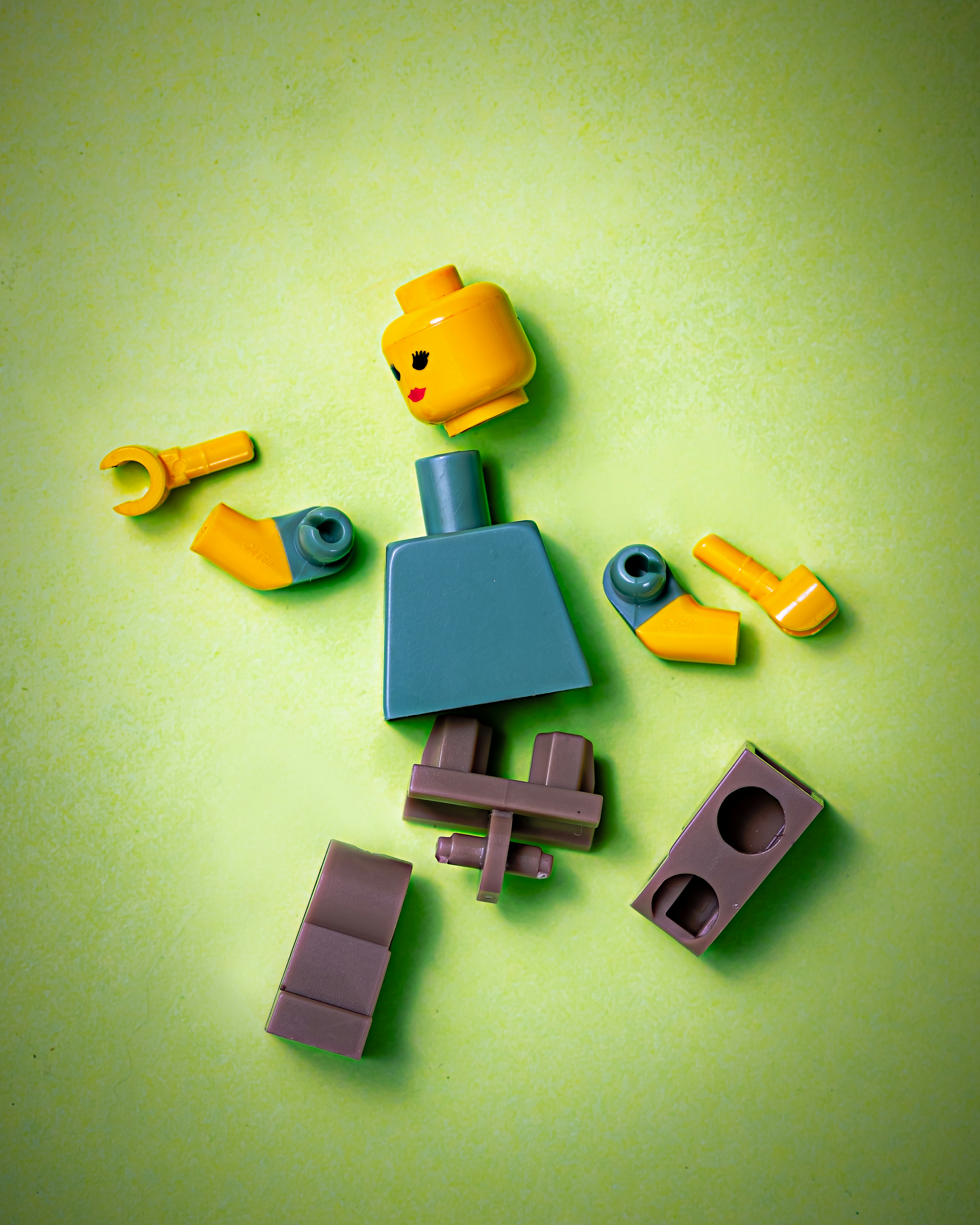
7 Things That Happen When You Don't Heal From Your Breakup
What actually happens when you skip the real work after a breakup: old attachment wounds, low self-worth, patterns that follow you into the next relationship, and why EFT is the tool that actually moves it.
read more
Emotional Gravity: Why You Keep Getting Pulled Back to the Same Kind of Pain
Behavioral expert Chase Hughes calls it emotional gravity: the reason you keep getting pulled toward the same kind of pain. It's not your intuition. It's your nervous system mistaking familiar for safe. Read the full breakdown.
read more